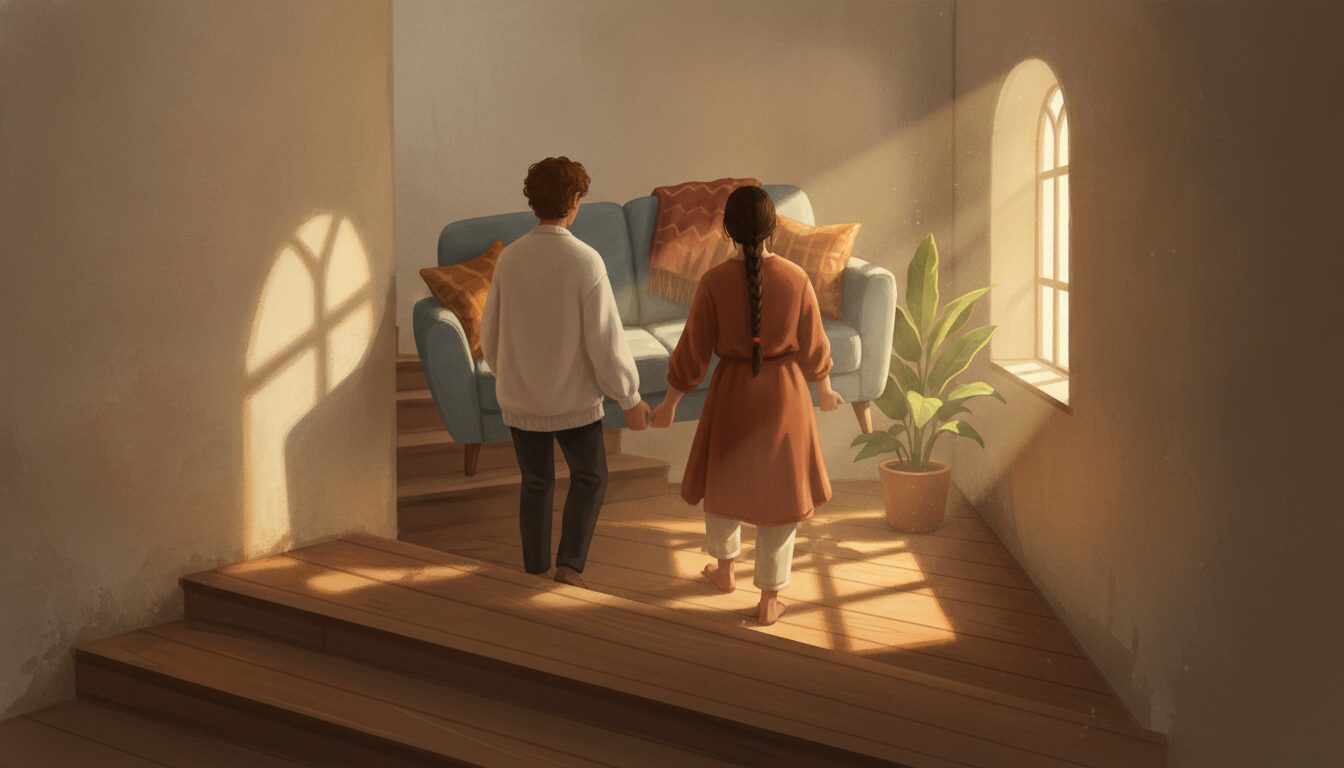

It is the evening of the 24th and you have been at your parents' place for twenty minutes. In your own city you run meetings, you turn down extra shifts in a calm voice, and last month you finally told a friend that a comment had hurt you.
Then someone at the table asks whether you are "still doing that job". Your brother makes the joke about your driving that he has been making since you were seventeen. And a voice comes out of you that you have not used in years, sharp and a little wounded. Ten minutes later you are lying on the bed in your old room with the door shut, scrolling your phone under the glow-in-the-dark stars still stuck to the ceiling.
On the train home the verdict arrives. All that work on myself, and one dinner undid it. Maybe I haven't changed at all.
Many therapists who work with families hear this story every December, and the explanation they give is kinder than the verdict, and more useful. It starts with a jacket.
The old jacket by the door
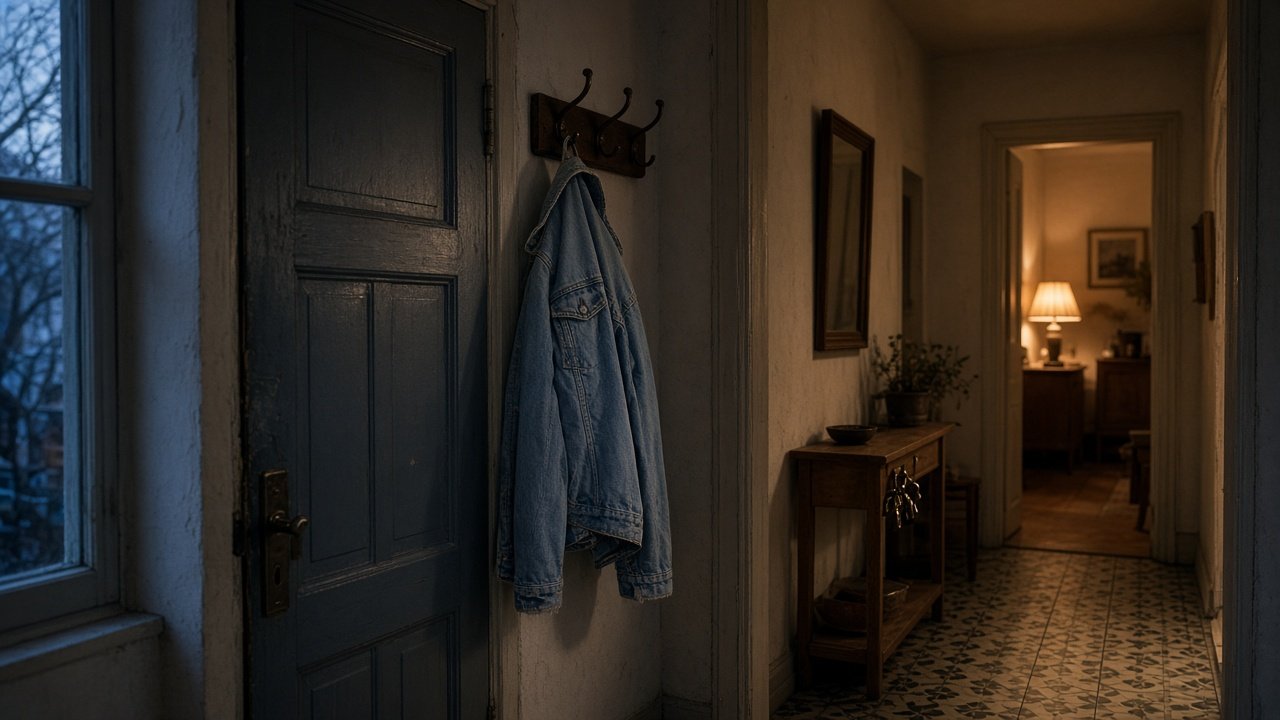
Imagine that in your parents' hallway there is still a jacket you wore at fifteen. Nobody throws it away. You walk in, your hands are cold, and before you have thought about it you have put it on. It smells of the house. The sleeves know where your elbows bend. It was made for the shape you had then, so it pulls a little across the shoulders.
Family roles work like that jacket. Each way of reacting that you used again and again as a child, in that house and with those people, was stitched to fit. Maybe you were the funny one when voices rose, or the one who went quiet. Oliver Burkeman, writing in The Guardian, quotes the therapist Marie Hartwell-Walker on the twenty or so years between birth and leaving home: "a whole lot of practice for making the family style and our role in it permanent."
Trisha Wolfe, a psychotherapist who writes for Psychology Today, describes the same thing as prediction. The brain keeps asking what a situation usually requires of you. When you walk into your childhood home, sometimes into the same seat at the same table, it pulls up the old records and gets you ready for what tended to happen there. In a sense the jacket is on the hook before you ring the bell. Wolfe also points out that these patterns once made sense. Staying quiet kept some children out of the line of fire. Looking after others gave some children a clear role, a way to belong.
Why home hands you the jacket
Shannon Sauer-Zavala, a psychologist who studies personality change, describes the family as a strong situation. Your family may still expect the old version of you, and expectations pull. The holidays add tiredness and stress. When we are stretched thin we fall back on well-practised responses, she writes, because they need less energy than the newer ones we are still learning.
You are also not the only person wearing an old jacket at that table. Wolfe notes that everyone is running patterns built in the same family, and that families tend to restore their usual balance when one person changes. If you stop playing your part, even a little, someone may hand the jacket back to you without meaning any harm. Sabina Natali, a psychologist in Turin, suggests a simple thing to watch at the holiday meal: where everyone sits. Does the same person always take the head of the table? What happens the year someone sits somewhere else?
This also explains why two siblings can leave the same dinner with different stories. Gery Karantzas, a professor of relationship science at Deakin University, writes that temperament changes how strongly a child is affected by the same parenting, so brothers and sisters can carry different memories of one house. He adds that stress tends to make our insecurities more prominent, and the holidays bring plenty of stress.
Your growth is still there
"Regression" is the word people reach for. Burkeman calls it closer to a poetic metaphor: modern psychology gives no real reason to think you literally return to an earlier stage of development when you start point-scoring with a sibling over dessert.
Sauer-Zavala offers a more accurate picture. A personality trait describes how you tend to think and act on average, across many situations. You can move that average, and some settings will still pull it up or down. She cites research showing that, on average, people become more emotionally stable and better at getting along with others as they age, with much of that change between 20 and 40, often after leaving the family home. Her line for the morning after: "A weekend of pleasing people or sensitivity doesn't undo all the changes you've made."
Wearing the old jacket for an evening does not shrink you back to fifteen. Your shoulders are still the size they are now. That is why it pulls. Wolfe suggests measuring progress another way: notice the old pattern a little sooner each time, and let the moment be "information rather than a referendum on your progress."
A fairer sentence on that train would be: "I put the old jacket on at dinner. I noticed it before dessert. Next time I'd like to notice before I snap."
Bringing your own coat this year
Hardly anyone gets through a family holiday without slipping into the old role at some point. What you can do is choose one place where you want to respond differently.
Pick one thing. Sauer-Zavala advises choosing a single change you have been working on, such as staying steady when you are criticised or saying what you would like, and keeping your attention on that one thing during the visit.
Make it concrete before you go. Decide on a small action, like telling your parents in advance what time you will leave on the 26th, or taking one breath before you answer the question about your job. A sentence you have prepared is easier to find under pressure: "I'm happy with my work, thanks. How's the garden?"
Talk to someone first. Karantzas suggests speaking to a close friend or a wise relative about what tends to go wrong, and finding an ally on the day, perhaps a sibling who understands. If you are going with a partner, agree on a signal that means "I need five minutes."
Step out when the pull is strong. A walk round the block or ten minutes doing the washing-up on your own both count, and you can come back once you have caught your breath. If you lie awake replaying the argument afterwards, our piece on replaying the conversation may help. For what to say when someone pushes back, see setting boundaries without guilt.
Before the visit, write down one of Wolfe's questions: if I did not play my old role this time, what do I think would happen? Often the honest answer is small and survivable, a raised eyebrow or a sulky silence. Sometimes it is not, and that matters too.
When the old role kept you safe
For some people the old role was protection. If keeping quiet or keeping everyone happy was how you stayed safe as a child, going home can stir up far more than irritation. We wrote about this in when keeping the peace was how you stayed safe. You are allowed to make the visit shorter, to sleep somewhere else, or to stay away. If there is violence or abuse in the family now, your safety comes first. If you are in danger now, call 999 or 112 (911 in the US). In the UK the National Domestic Abuse Helpline is 0808 2000 247; in the US, the National Domestic Violence Hotline is 1-800-799-7233. A doctor or a local support service can help you plan.
If the weeks around the holidays leave you low for a long time, or family contact keeps reopening old pain, think about seeing a psychologist or a family therapist. Natali writes that in her Turin practice she sees more patients arrive right after the Christmas holidays. Asking for help in January is common.
If you are having thoughts of hurting yourself or of not wanting to be here, do not wait for an appointment. If you might act on these thoughts soon, or you have already hurt yourself, call 999 or 112 now (911 in the US). To talk to someone, in the UK and Ireland call Samaritans on 116 123 at any hour, and in the US call or text 988.
Sometimes the hardest moment comes at midnight in your childhood bedroom, when the house is asleep and there is nobody in it you can say this to. NoOneToTalk offers anonymous peer listening 24 hours a day, so you can write "I'm at my parents' and I feel fifteen again" to someone who will simply listen. It is a place to talk. It is not therapy, and it does not replace a doctor.
This year, choose one moment where you want to answer as the person you are now, and decide today what you will say. If you find the old jacket on your shoulders anyway, notice it, and take it off when you can.