
Sunday, twenty past seven in the evening. The argument started with the electricity bill, which was due on Friday and is still on the fridge under a magnet shaped like a lemon. Ten minutes later nobody is talking about the bill. You have said “you never notice anything”. Your partner has said “here we go again”. Now one of you is rinsing a glass that is already clean, and the other is scrolling a phone without reading a single word.
Under the silence, a quieter thought arrives. Couples who are fine do not fight like this. Maybe we are broken.
That thought feels like common sense, and it deserves to be checked. What follows is general information about everyday conflict between partners. It is not couples therapy, and if arguments at home involve fear, threats or violence, the section near the end is for you.
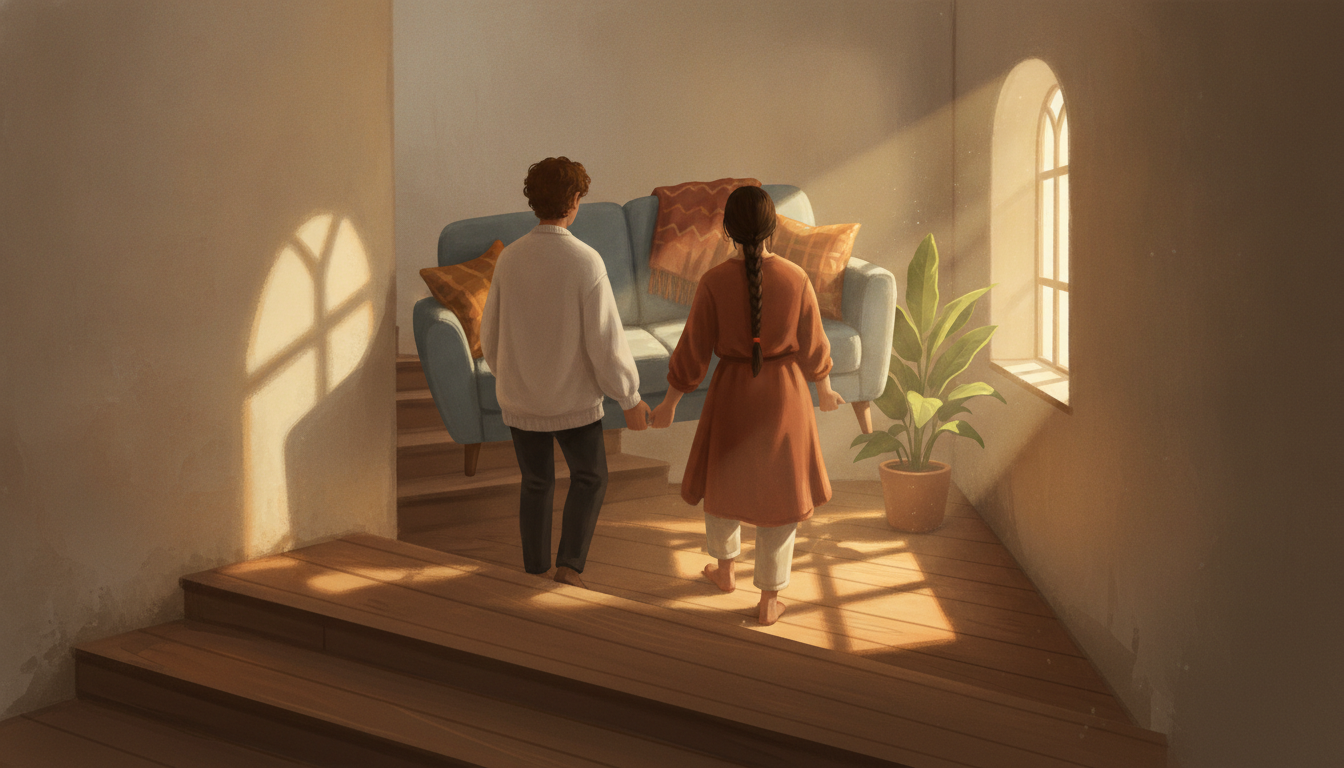
Two people carrying a sofa up the stairs
Picture the two of you carrying a sofa up a narrow staircase. Living together is a lot of carrying: money, chores, families, tiredness, plans. On the straight flights it goes fine. Then comes the turn, the place where the stairwell bends, and each of you sees a different way through. You pull left. Your partner pushes up. The sofa scrapes the wall, someone's fingers get squeezed, and both of you start shouting instructions the other cannot hear.
An argument is that turn in the stairs. It happens to every pair who carry something heavy together, because two people standing at opposite ends of the same load see it from different angles. The scraped wall says something about the turn. It says very little about whether you should carry things together.
What matters more is what happens next. Some pairs keep pulling until the sofa falls. Others say “wait, put it down” and rest it on the landing for a minute.
The landing has a name
The couples researcher John Gottman calls that moment a repair attempt. In a piece on the Gottman Institute blog he and his team describe how they studied, in their Love Lab, the ways people try to make things better in the middle of a fight. One finding is reassuring for anyone who feels clumsy: how elegantly the repair was made did not predict whether it worked. Some beautifully worded repairs went unheard. Some awkward ones, even a silly grin, landed.
The difference, they write, lay in the emotional climate between the two people, the friendship built on ordinary days. A repair lands more easily on a landing where you have been kind to each other lately.
So a repair can be small. “Can we start this again?” “I'm getting loud, give me a minute.” “I'm on your side, I just hate this bill.” A hand on the shoulder. A bad joke about the lemon magnet. None of these solve the bill. They get you to the landing.
Putting the sofa down without dropping it
Resting the load is different from walking away from it. The Italian psychotherapist Catia Solari suggests that when tension climbs (loud voices, a racing heart, thoughts coming too fast) partners take a twenty minute pause with a precise agreement to come back, such as “let's talk again at six”. The return time is what keeps the pause from turning into punishment.
While the sofa rests, your body has a job to do. Breathe slowly, walk to the corner shop, drink some water. Coming back to the stairs with your hands still shaking usually means a second scrape at the same turn.
Looking at the turn together afterwards
Once both of you are calmer, the Gottman Institute offers an exercise called The Aftermath of a Fight, described in a post on its blog. The steps are simple to read and harder to do. Each person first names only the feelings they had during the fight, without explaining or arguing. Then each describes what happened from their side while the other listens and acknowledges that this was real for them. Then you talk about the older sensitivities the fight touched, take ownership of your own part, and agree on one thing each of you could do differently next time.
The author of that post opens with a huge fight about a cat's litter box, and admits it sounds ridiculous. That honesty is useful. Many arguments are about the litter box on the surface and about feeling alone or unappreciated underneath. In the Sunday scene, the bill was the sofa. “You never notice anything” was the turn in the stairs.
Taking ownership can be one plain sentence: “I said never, and that wasn't fair.” It does not have to wait for your partner to go first.
When the turn is too tight for two
Some staircases are harder than others. If the same fight comes back every week, if neither of you can put the sofa down anymore, or if one of you has started carrying everything in silence to avoid the next turn, a couples therapist can help you see the pattern from outside. If you want to rebuild after something more serious, our piece on repairing trust after a betrayal goes further, and setting boundaries without guilt may help when the issue is space.
Everything above assumes two people who are both safe. If you are afraid of your partner, if arguments include threats, being blocked from leaving, controlling your money or phone, or any physical harm, that is not a turn in the stairs, and repair exercises are the wrong tool. In that situation couples therapy is not the right first step either. A domestic violence service can talk with you on your own first. Contact local emergency services if you are in danger, or a domestic violence helpline in your country. Our article when keeping the peace was how you stayed safe talks about what living on alert can do to a person.
Sometimes the hardest part is saying out loud, to someone outside the relationship, “we fight and I'm scared it means something”. NoOneToTalk offers anonymous listening from peers, a place to say it without taking sides or being judged. It is a place to talk. It is not therapy, and it is not couples counselling.
Tonight the bill is still on the fridge. Before anyone pays it, one of you can walk over to the sink and say, “Can we put this down for a minute?”
If you or someone you know is in crisis, please seek help. International directory: findahelpline.com.