
Your partner comes home and sets the keys on the table a little harder than usual. Nobody has said a word yet. You are already up from the sofa, already asking if they're hungry, already apologizing for something you can't name. Your voice has gone half a step brighter. Later you won't remember deciding any of it.
If that sequence feels familiar, you probably know the label people-pleaser. Trauma clinicians have another name for one version of it. The psychotherapist Pete Walker, in his 2013 book Complex PTSD: From Surviving to Thriving, described fawning as a fourth survival response next to fight, flight and freeze: staying safe by appeasing the person who seems dangerous. Fawning is a clinical framework. It is not a diagnosis, and this text is general psychoeducation. It does not replace an assessment by a mental health professional.
A barometer facing the wrong way
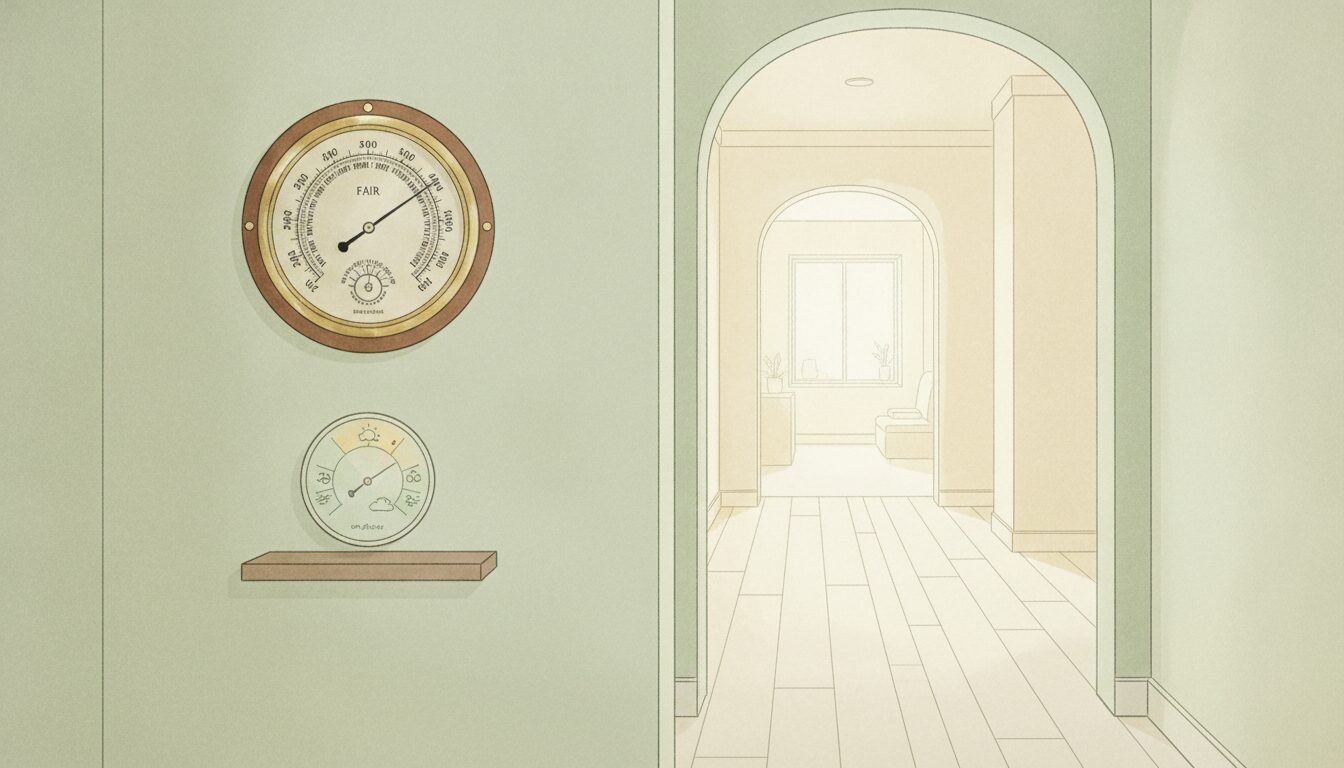
Picture a child in a house where one adult's mood decides what the evening will be. The child learns to read pressure. The way the car door shuts. How a spoon hits the bowl. Whether the television goes on or stays off. Long before anyone explains anything, the mind builds a small barometer and hangs it on the wall facing outward, toward the other person's weather.
It is a clever instrument. It warns early. It lets a child tidy the kitchen, turn the music down, offer a smile before the storm breaks. In that house it often worked, and the mind keeps what works.
The trouble is what the mind never installed. There is no gauge facing in. So years later someone asks where you'd like to eat, and you go blank. You say "whatever you prefer" and mean it literally, because the dial that would show your own preference was never put on the wall. The outward barometer, meanwhile, keeps working in every room: the office, a friend's flat, the kitchen of someone who treats you well. In those places the storm it is waiting for does not come.
Why it passes for kindness
Fawning is hard to spot because it earns praise. In a 2025 interview with The Psychologist, the clinical psychologist Ingrid Clayton, author of a book on fawning, said it "hides in plain sight". It tends to look like being the good kid, the peacemaker, the one everyone can count on. Teachers like it. Managers like it. The cost stays inside, as tiredness, a jaw that aches at night, a vague resentment with nowhere to go.
Kindness and fawning can produce the same sentence. The difference is what happens inside before it. Kindness has room in it. You check, you decide, and if you said no you'd feel a little sorry and get on with your day. With fawning, the yes is out before you have checked anything, and even imagining a no makes your stomach tighten, as if someone were about to catch you out.
What it is, and what it is not
Being agreeable does not by itself point to trauma. Temperament, culture and jobs that reward smoothness all shape how easily we say yes. Fawning describes a yes that is driven by fear and arrives automatically, often learned where disagreement once had a real price. If that sounds like a long stretch of your childhood, our pieces on what complex PTSD looks like day to day and on why surviving is not the same as feeling safe go deeper into how that kind of history stays in the body.
One case needs saying plainly. If you live or work right now with someone whose anger is dangerous, fawning may be part of what is keeping you safe today. Dropping it as a self-improvement project could put you at risk. In that situation the first step is support and a safety plan, from a domestic violence service, a doctor or a person you trust, before any work on boundaries. You can find local crisis and domestic-violence helplines at findahelpline.com.
Hanging a second gauge, facing in
You don't need to take the old barometer down. It reads people well, and that skill can stay. The work is to hang a second one beside it, facing you.
Start where the stakes are low. When someone asks you for something, give yourself three seconds before answering. Notice your stomach, your shoulders, your throat. Ask one question: what would I say if nobody were going to be upset? You don't have to say it. You are only reading the new gauge, and at first the needle will barely move. That is normal for an instrument that has never been used.
Then practice out loud with people who already feel safe. Pick the film. Say you'd rather walk than take the bus. Sam Dylan Finch, who writes about mental health, described their own fawning and the habit of putting a strawberry emoji next to the names of friends who were warm and steady, so those messages would be a reminder to prioritize people who are kind and emotionally available. Small choices with people like that teach the body that a preference can be spoken and the room stays calm.
Expect a wave of guilt after a small no, sometimes hours later. That is the old barometer reacting to a change in pressure. It is information, and you don't have to take the no back. There is more on this in setting boundaries without guilt.
When to look for support
Fawning was learned inside relationships, and it usually loosens inside them too. A trauma-informed therapist can be a place to disagree out loud and watch the other person stay. If saying something true still feels too exposed, NoOneToTalk offers anonymous conversation with other people and with Kibo, a place to try a sentence that starts with "actually, I think". It is a place to talk. It is not medical treatment.
See a doctor or a mental health professional if you no longer know what you want or feel, if the people you keep appeasing are hurting you, or if the effort of keeping everyone calm has left you drained or low for weeks. If you have thoughts of dying or of hurting yourself, contact local emergency or crisis services now.
The next time keys land a little hard on a table, you will probably feel the old needle jump. Let it. Then, before you offer anything, look at the other gauge and see what it says.