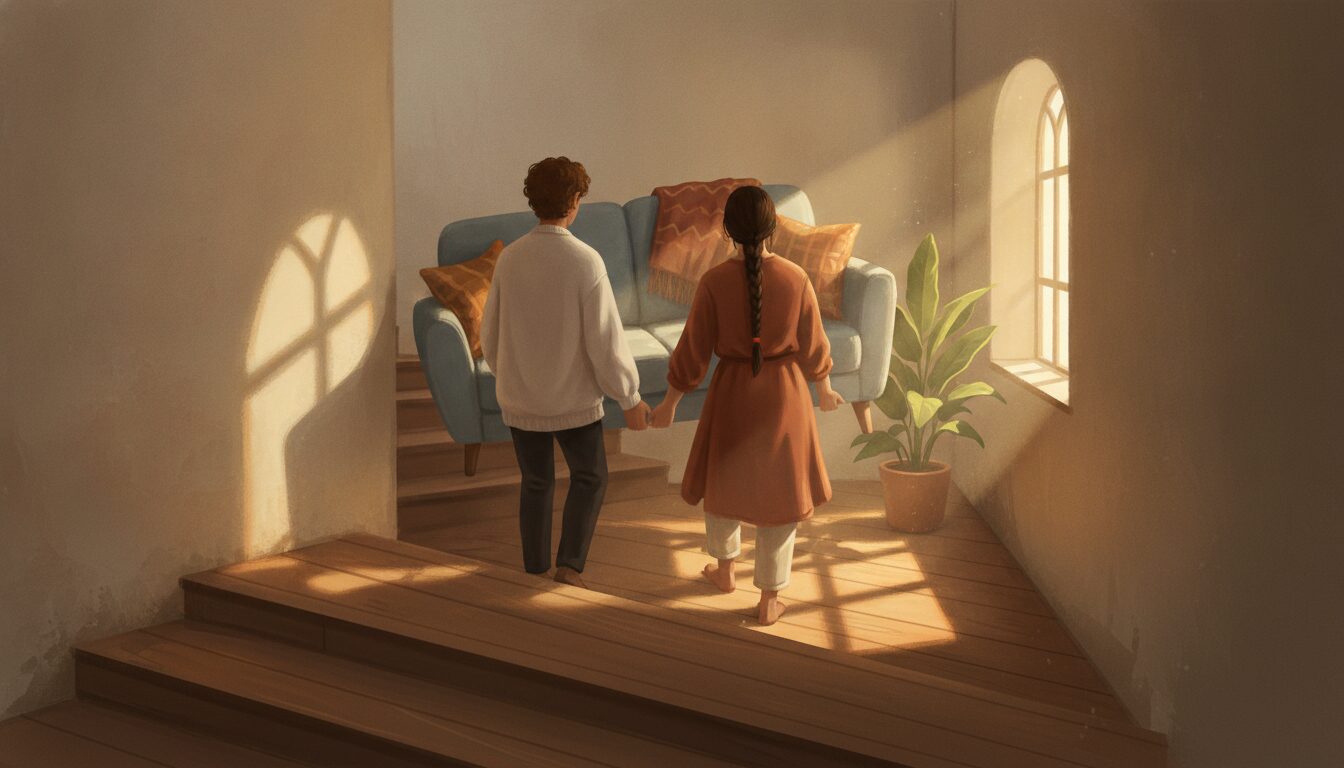


You are on the sofa together. The TV is on low. Two phones glow in two laps. Someone asks what day the rent leaves, and the answer is correct. Ten minutes pass. Nothing cruel happens. Still, your chest feels as if the room got larger while the furniture stayed put.
Later you wash a cup and wonder why "we had a quiet night" sounds like a report, not a memory. You were never alone. You also never quite landed in the same conversation.
Loneliness is often pictured as an empty apartment, a Friday with no plans, a bed that stays cold. That picture is real for some people. For others, the ache arrives next to someone: shared keys, shared calendar, shared silence that does not rest. Proximity without contact can feel lonelier than an evening alone, because the expectation of closeness is right there and still out of reach. This text is general psychoeducation. It is not a diagnosis of your relationship and does not replace couples work or individual care.
Two radios, different stations
Picture two radios in the same room. Both are on. One plays news. The other plays music. The volume is polite. Neither is broken. The noise fills the air, yet neither set can hear the other as a partner.
That is one way relational loneliness can feel. Bodies share a kitchen. Schedules sync. The emotional stations stay apart. You speak about groceries and school pickup. You do not speak about the joke that failed earlier, or the fear that sat in the car with the windows up, both of you looking at the road.
The radios image is a teaching picture, not a verdict. Couples go through quiet seasons. Stress, illness, new babies, money pressure, grief, and depression can pull attention inward. Loneliness beside someone can also grow from habits: phones as the first and last touch of the day, conflict that never gets repaired, or a rule that feelings are "too much." Naming the pattern does not mean the bond is doomed. It means the static deserves a word.
Sometimes both radios are loud with logistics and neither finds a quiet channel for feeling. You can spend a whole weekend "together" in shops, cars, and queues, and still go to bed with the sense that nobody asked how the week landed in your body. Shared activity is useful. It is not automatic contact.
A useful distinction
Solitude is chosen quiet. You close a door, walk without headphones, or sit with a book and return with a little more room inside. Relational loneliness is different. You are present with a person who matters, and you still feel unseen, unheard, or reduced to logistics.
The first can restore. The second drains. Confusing them is easy when the calendar looks full of "us time" that never becomes contact. A date night that stays on the surface can leave you more empty than a night alone with one honest friend on the phone.
This distinction matters because shame often arrives next. People tell themselves they should be grateful. The mortgage is paid. Nobody yelled. How dare you feel alone? Gratitude for practical safety and hunger for emotional contact can sit in the same body. One does not cancel the other.
What the days can look like
Morning: a kiss that lands like a habit. Midday: a message about milk. Evening: parallel screens, then sleep. You notice you rehearse what you want to say and then decide it is not worth the risk. Or you say it sideways ("You're always on your phone") and get a defensive shrug that closes the channel for another week.
Friends may see a stable couple. Photos look warm. Inside, you ration vulnerability the way some people ration money: only for emergencies. That rationing protects against another shrug. It also starves the very closeness you miss.
Some people over-function. They plan, ask, initiate, then burn out and go quiet. Others under-function. They wait to be invited and read every silence as proof they are unwanted. Both can feel lonely in the same kitchen. Neither pattern proves who is "the problem." Both are signals that contact has thinned.
If the loneliness sits with fear, control checks, or a sense that love means monitoring, read our piece on closeness when love starts to feel like surveillance. If saying a need feels like betrayal, setting boundaries without guilt may help you script one plain sentence. If the empty feeling starts to flatten mood for weeks, our note on when loneliness becomes depression is a related door, not a label you must wear.
One small turn toward contact
Start smaller than a "we need to talk about us" summit. Pick one bid you can actually make tonight: "Can we put the phones in the kitchen for fifteen minutes and tell each other one true thing from the day?" Keep it timed. Keep it to one topic. Curiosity beats prosecution.
If you are the one who usually initiates, try naming the load without a courtroom tone: "I miss hearing what your day felt like, not only what it contained." If you are the one who usually retreats, try one concrete offer: "I have energy for a short walk after dinner. Want to take it with me?"
Repair after a miss also counts. "I answered about the dishwasher when you were asking about feeling alone. Can we rewind for two minutes?" Two minutes will not rebuild a year. They interrupt the story that contact is impossible.
You can also write the sentence first, if speaking still feels sharp. A short note on paper or in a shared draft: "I feel lonely beside you sometimes. I am not accusing you of being a bad partner. I want us to practice hearing each other again." Writing is not cowardice. It is a ramp when the voice shakes.
If every attempt turns into contempt, stonewalling, or fear for your safety, stop using this article as a DIY manual. Speak with a qualified professional, and if you are in danger, use local crisis services first. An anonymous peer space can hold the sentence "I feel lonely next to them" without forcing you to decide the whole future tonight.
How NoOneToTalk can sit with you (without replacing therapy)
NoOneToTalk offers anonymous conversation with peers, with Kibo, and, when it fits, therapist rooms. It is a low-threshold place to practice saying the awkward line before you say it at home, or to sit with the ache when home is not ready. Couples therapy, when available and safe, remains the stronger container for two-person repair. Peer chat does not replace that work.
If tonight you only need to put one true line somewhere safe, start at downloads. You do not have to wait until the house is empty to admit you feel alone. Naming the two radios is already a form of contact with yourself.
Shared air is not the same as shared listening. One station change, one short window without screens, can be enough to test whether the signal still answers.