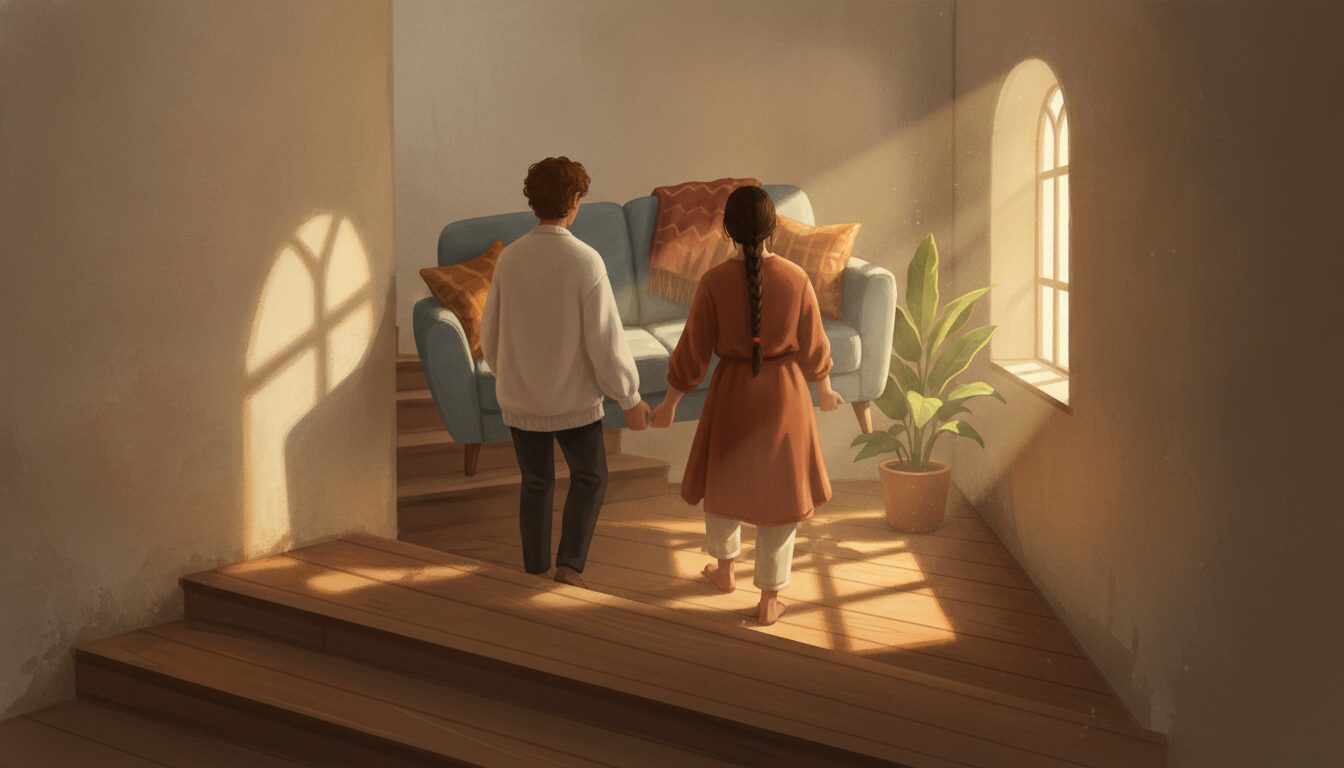


Thursday, half past eight. Two plates of pasta on the table, the radio on low. Across from you, your partner is explaining the boiler: the engineer can come on Tuesday, but only between eight and twelve, so one of you has to work from home. You nod. You are looking at the salt cellar, and you realise you have been looking at it for a while.
Four years ago you sat up until two in the morning in a kitchen half this size, talking about nothing, and it felt like the best conversation of your life. Tonight the most interesting thing at the table is the boiler.
Then the thought arrives, quiet and cold. Maybe I don't love them anymore. Maybe this is what the end looks like.
This article is about that thought, in a relationship that is basically kind and has gone quiet and flat. It is general information. It is not couples therapy, and it is not written for relationships where there is fear, control or violence. If that is your situation, the part near the end is for you.
The street you stopped seeing
Think about the first weeks after you move to a new neighbourhood. Everything asks to be looked at. The blue door with the brass knocker. The bakery that smells of aniseed at seven in the morning. The old man who waters his geraniums at the same hour every day and nods at you. You walk slowly, and you take the long way just to find out what is round the corner.
Two years later you walk to the bus stop with your head somewhere else. You could not say what colour that door is. Nothing has been knocked down, and the bakery is still there. Your mind has learned the route, and a mind that knows the way stops spending attention on it.
Something similar happens with a person. At the start every story is new, and every small habit of theirs is information. Then you learn them. You know how they take their coffee and which song they will skip. Knowing someone turns a new street into your street.
So the flatness on a Thursday evening is often the sound of familiarity. It can also be a sign that the two of you have stopped going anywhere new together. Both can be true at once. Neither of them, on its own, means the love has gone.
What researchers found about boredom in couples
Boredom in long relationships has a small research literature of its own. Writing for the psychology magazine In-Mind, the researchers Greg Strong, Frank Fincham and Arthur Aron describe it as an absence: little positive feeling, and little drive to move towards anything together. They point out that it turns up even in relationships that are otherwise good and satisfying. Couples who argue, they add, are at least doing something.
That does not make boredom harmless. In a study described by Stony Brook University, Irene Tsapelas, Arthur Aron and Terri Orbuch interviewed 123 married couples in the United States seven years into their marriages and again nine years later. Those who said at year seven that their marriage felt like a rut, the same things all the time and rarely anything exciting together, had a bigger drop in satisfaction by year sixteen. The researchers' reading was that boredom reduced closeness, and the lost closeness is what pulled satisfaction down.
Turn that finding round and it becomes useful. A rut tells you something about the shape of your days together. It says nothing final about the person across the table.
One honest limit. Most of this work comes from married couples in the United States, and it describes averages. Your relationship is a single case, with its own history.
Taking a different street, together
Back to the neighbourhood. You do not have to move house to see it again. You take a different street on purpose, and it works better when you take it with someone.
That is roughly what Aron and his colleagues tested. As the In-Mind authors summarise, couples who did new and exciting activities together reported better relationship quality afterwards, and this held for couples who had said they felt bored. Another study they cite found a gentler version: ordinary shared tasks such as cooking or looking after the children could help too, when the couple got absorbed in them together. In the Stony Brook release, Aron's suggestion was one evening a week doing something you have never, or rarely, done together.
The different street can be small. A recipe from a country neither of you has visited, cooked badly. The bus to the end of the line on a Sunday morning, with no plan for when you get off. A class where you are both beginners and both slightly ridiculous. You learn something side by side again, and you get to watch the other person in a situation they have not mastered yet.
Lisa and Gavin, a couple who told the Guardian about three decades together, describe stretches when they felt more like housemates. In those periods, Lisa says, they had to make an effort: making each other laugh, putting music on, dancing in the kitchen. Gavin's line is worth keeping. 'The thrill still exists in the familiar.'
You can also name the flatness out loud, gently, without turning it into a verdict. 'I miss us. Shall we try something new on Saturday?' lands very differently from 'We never do anything anymore.' The first is an invitation. The second sounds like a fact and works like an accusation.
When the quiet is something else
Familiarity is one reason a relationship goes flat. There are others, and they need different things.
If the flatness is everywhere, it may have more to do with you than with the relationship. Losing interest in friends, food, work and hobbies as well, feeling hopeless most days, a drop in sex drive that came with all the rest: the NHS lists these among the signs of depression and advises seeing a GP if symptoms last most of the day, every day, for more than two weeks. We wrote about what that can feel like in depression is not only sadness.
If the quiet hides things you have both stopped saying, small resentments that were never talked through, it may be closer to avoidance than to calm. Our article on why arguing does not mean your relationship is failing looks at how couples repair after conflict, and lonely beside someone is about feeling alone while you are together.
And if the quiet is the careful kind, because you are afraid of how your partner will react, that is a different situation. Threats, controlling your money or your phone, stopping you from seeing people, any physical harm: none of this is a rut, and the ideas above are the wrong tool for it. If you are in danger, contact local emergency services now. A domestic abuse helpline in your country can talk with you on your own, without your partner there. Our article when keeping the peace was how you stayed safe looks at what living on alert does to a person.
If you need to say it out loud first
Sometimes the thought 'maybe I don't love them' is too heavy to bring to the person it is about, and too private for friends who know you both. Saying it to someone outside the story can help you hear what it actually means. NoOneToTalk offers anonymous listening from peers, 24 hours a day. It is a place to talk. It is not therapy, and nobody there will tell you whether to stay or go. If you both want to work on the relationship, a couples therapist is the more direct route.
Next Thursday the boiler is fixed. On the way home you both get off the tram one stop early, at the market neither of you ever walks through, and buy a fruit you cannot name. Nobody knows how to cut it. You end up laughing at the sink with juice running down your wrists, in the same kitchen as always.