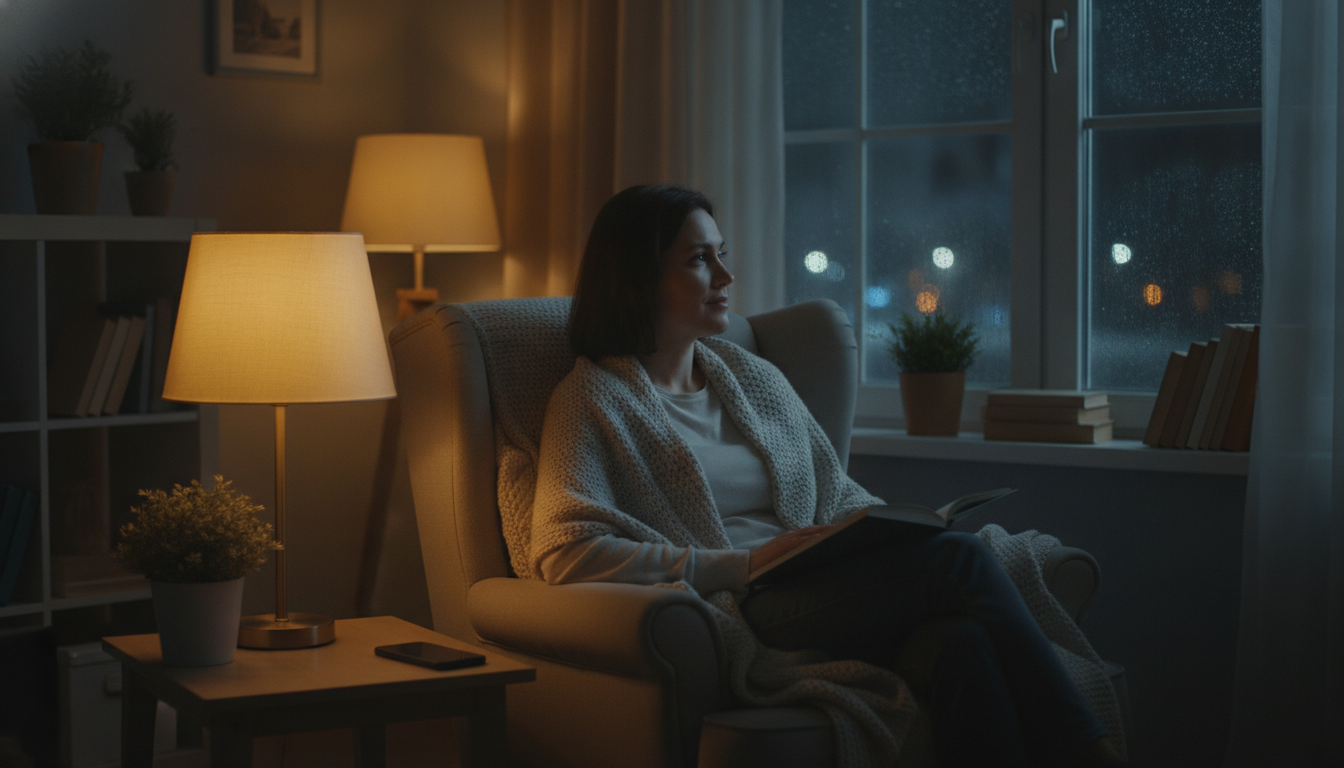

Saturday, ten past one in the morning. Dinner at your friend's flat ended more than two hours ago. Teeth brushed, phone on charge, light off. Your mind is still at the table.
Somewhere between the pasta and dessert, she told everyone she had quit her job to start over. You laughed and said “brave or crazy, right?” She smiled and passed you the bread. The whole thing took about four seconds.
Since you got home you have watched those four seconds maybe thirty times. With each viewing her smile looks a little thinner, and your laugh a little louder.
The replay feels like homework. If you work out exactly where you went wrong, the mind reasons, it will never happen again, and nobody will see you that way again. That promise rarely holds, and the reasons are worth knowing at one in the morning. What follows is general information about a common anxious habit. It is not a diagnosis and does not replace a doctor or a mental health professional.
A projector stuck on one scene
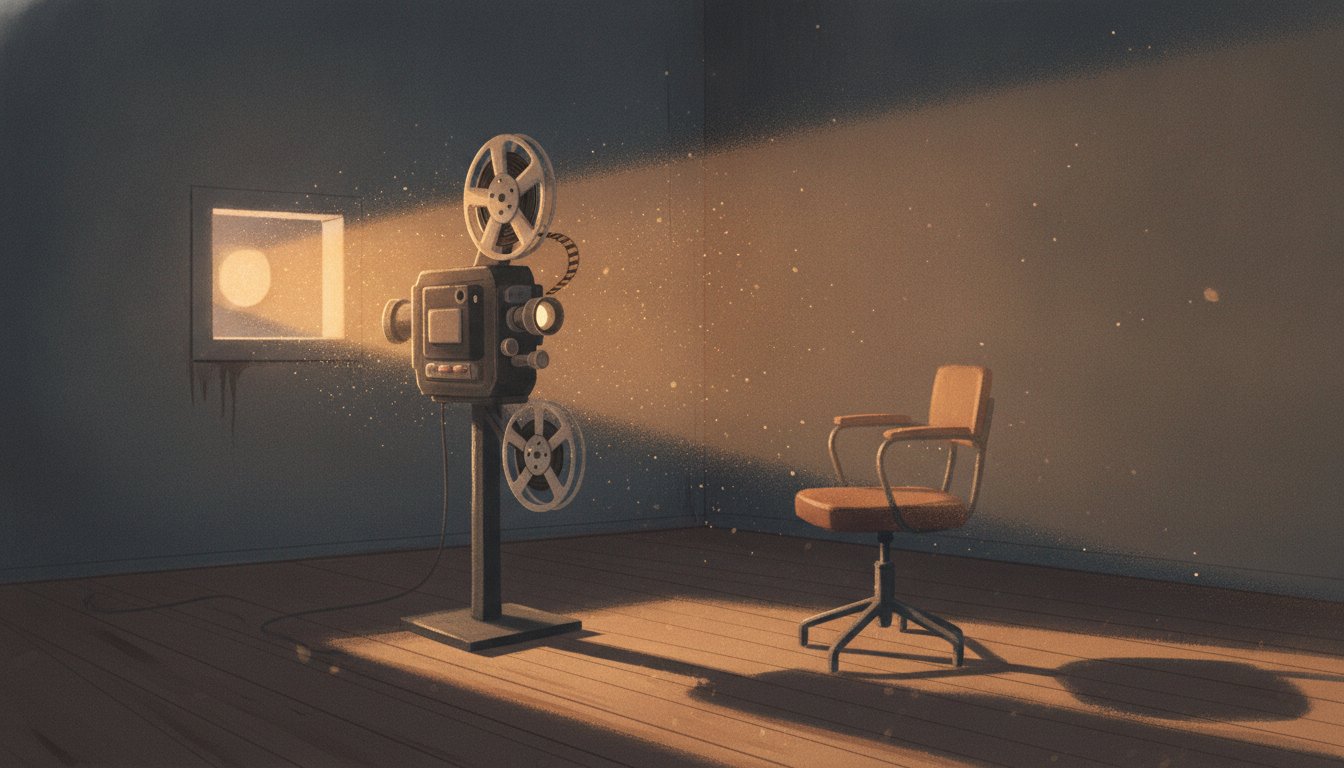
Picture a small projection booth at the back of your head. After a conversation that mattered, someone in there threads the reel and starts rewinding. The rest of the evening gets skipped. Only the four seconds are shown, again and again.
Look at how that film was shot. During dinner, part of your attention was turned on yourself: how your laugh sounded, whether your face was going red, what to say next. The camera was pointing at you. So the reel holds plenty of footage of you and almost none of her.
The Italian psychologist Gianni Trudu describes this in a short story on his blog about a client he calls Marco. Marco is a teacher who keeps going back to a staff meeting where he stayed silent. Asked what he noticed while he was about to speak, Marco cannot remember what the head teacher said. He remembers his own voice and his own breathing.
Research points the same way. In a series of studies published in 2018 in Psychological Science, a team led by the psychologist Erica Boothby had strangers talk to each other and then asked each person how much they thought their partner had liked them. People consistently underestimated it. Analysis of video from the conversations suggested that partners had been signalling interest, and that the participants, busy with their own self-critical thoughts, had not taken those signals into account. The researchers called this the liking gap.
Why the replay feels like preparation
The mind gives the replay a respectable job title. Its reasoning goes: if I go over what I did wrong, I will do better next time. The Danish clinical psychologist Pia Callesen quotes that very sentence in a guide for Psyche, as one of the beliefs that keep overthinking going. Her suggested test is to ask yourself whether all that going over it has ever actually led you to better decisions or more control.
Useful reflection does exist, and you can recognise it by its shape. It is specific, and it ends in something you can do. You talked over a colleague, so next time you will wait for her to finish the sentence. One pass is enough for that.
The thirtieth pass of the four seconds adds no new footage. The booth has only the one reel, and every rewind scratches it a little more. A 2024 review in the Journal of Psychiatric Research pooled the research on what psychologists call post-event rumination and found it linked with symptoms of social anxiety. The authors also note that people with higher social anxiety tend to remember more negative details about their own performance, even after receiving positive feedback. The link is a correlation, so it cannot tell us which comes first.
Anxiety edits the film before it shows it to you.
If this sounds like a close relative of the worry that dresses up as responsibility, it is. We wrote about that one in when worry feels like care. The replay is the same habit facing backwards, while anxiety that lives in the future faces forward.
What to do when the reel starts at 1 a.m.
Fighting the projector rarely works. Ordering yourself to stop thinking about it tends to bring the scene straight back, and arguing with it (“it was fine, she didn't mind”) can turn into one more round of checking. These moves tend to help more.
Name the film. Say to yourself, “this is the replay.” Those four words move you from inside the scene to the back of the booth, where you can see the machine running.
Ask one question with a yes or no answer. Is there something here to repair? If yes, write the repair now as a draft and send it tomorrow, in daylight: “Last night I said brave or crazy. It came out wrong. I think what you're doing is brave.” Two or three sentences are enough, and once they are sent the scene has an ending, whatever she replies. If the answer is no, the reel has nothing left to give you. Texting three friends “did I embarrass myself tonight?” can keep it spinning. Callesen counts seeking reassurance among the strategies that feed worry once you depend on them to calm down.
Give it an appointment. Callesen suggests a fixed daily slot for worry and rumination, for example half an hour at 7.30 in the evening, kept well away from bedtime. When the scene comes back at one in the morning, the answer is “later, at 7.30.” By then, she writes, thoughts that felt urgent often seem less important.
Do something, almost anything. In a 2023 experiment in the Journal of Anxiety Disorders, researchers in Ontario, Canada, asked 92 adults with social anxiety disorder to go through a stressful social task. Each person was then randomly assigned one of three short exercises (two guided ways of thinking, one concrete and one abstract, or a distraction task) or no exercise at all. All three exercises reduced the replaying and improved how people saw themselves, compared with doing nothing. Without an exercise, the replaying stayed high for up to a month. The paper's title says it plainly: “Just do something.” At one in the morning that can mean getting up for a glass of water, putting on a podcast you know by heart, or trying one of the grounding techniques that work when anxiety spikes.
If the replay tends to start as soon as the house goes quiet, the night may need attention too. The mind that never clocks out looks at that state of permanent alert.
When the replay takes more than one night
An occasional rerun after an evening that mattered is part of caring how you treat people. Talk to a doctor or a psychologist if the replays follow almost every conversation, if they last for hours, if they have been costing you sleep for weeks, or if you have started cancelling plans so there is nothing to replay. This pattern responds to treatment. A 2024 review of 26 studies, also in the Journal of Anxiety Disorders, found that psychological treatment, cognitive behavioural therapy in particular, substantially reduced rumination after social events in adults with social anxiety.
Some replays are about something else: a conversation that involved threats or fear. That is a different situation from an awkward joke, and it deserves support from a professional. If you have thoughts of hurting yourself, contact local emergency or crisis services now.
Saying the four seconds out loud to someone who was not at the dinner can make them easier to put down. NoOneToTalk offers anonymous listening from peers, a place to say “I can't stop replaying something stupid I said” without explaining who everyone is. It is a place to talk. It is not therapy, and it is not medical treatment.
Tomorrow, if the line still sits wrong, send her those lines. Then let the reel run past the four seconds, into the part the projector keeps cutting: the coffee, the long goodbye at the door, her saying “come again soon.”
You were there for that part too.
If you or someone you know is in crisis, please seek help. International directory: findahelpline.com.