
Tuesday, ten to seven. You are in the queue at the supermarket with a basket on your arm: pasta, washing-up liquid, a bag of clementines. The till beeps for the person in front. Then, from nowhere, your heart starts hammering as if you had run up four flights of stairs. Your fingers tingle. The strip lights seem too bright, and the queue looks slightly far away, as if you were watching it on a screen.
A thought arrives, very fast and very sure. I'm going to collapse here. I'm losing my mind, in front of everyone.
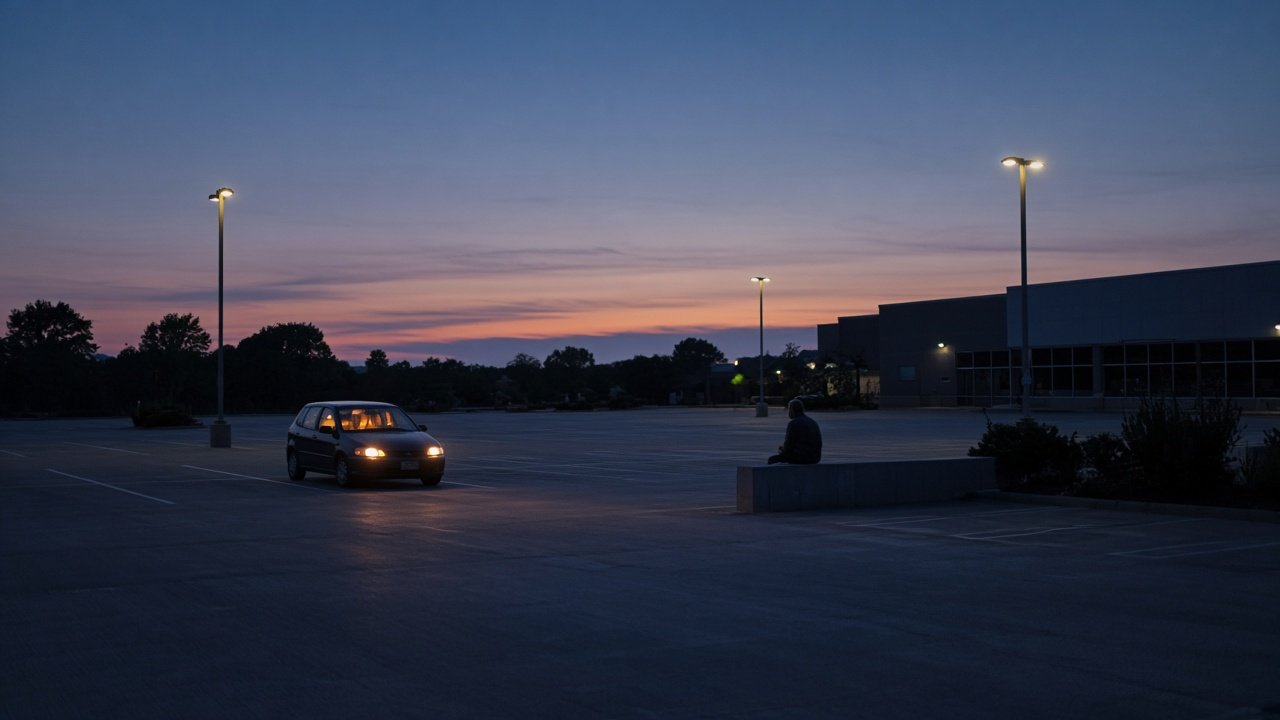
You put the basket down next to the frozen peas and walk out to the car park. You sit on the low wall by the trolleys with your hands pressed on your knees. Twelve minutes later, more or less, it fades. You feel emptied out and a little ashamed. You drive home without the pasta, and you tell no one.
This article is about that moment and the fear it leaves behind. It is general information. It is not a diagnosis and it does not replace a doctor. If you have chest pain right now, go straight to the third section.
A car alarm on a quiet street
Some car alarms are set so sensitively that they go off for almost nothing. A scooter passes too close. A cat jumps on the bonnet. A lorry shakes the road at three in the morning. The alarm has no way of measuring how big the threat is. It screams at full volume every time, the lights flash, and the whole street wakes up.
The noise is completely real. You can hear it from four floors up. What is missing is the thief.
A panic attack works in a similar way. Your body has an alarm system for danger, the one that gets you ready to fight or run: the heart speeds up, breathing gets faster, you sweat. In a panic attack that system goes off at full volume with no danger in the room, or for a small trigger, such as a thought, a crowded place or a sensation in your own chest. The psychiatrist Álvaro Cabral Araújo, interviewed by Folha de S.Paulo, describes it as the brain's threat-detection circuits firing and producing the physical reactions that prepare us to face danger.
So the feeling that you are losing control belongs to the alarm. It tells you how loud the siren is. It tells you nothing about whether anyone is breaking in.
Why it feels like the end
Part of what makes panic so frightening is how physical it is. The NHS page on panic disorder lists, among other symptoms, a racing heartbeat, chest pain, shortness of breath, a choking sensation, pins and needles, a feeling of dread or of dying, and feeling as if you are not connected to your body. The mental health charity Mind names the fears that tend to come with them: losing control, fainting, having a heart attack, dying.
Then there is the speed. According to the NHS, most panic attacks last between 5 and 20 minutes, and Araújo says they peak within a few minutes. From the inside those minutes do not feel limited at all. They feel like the beginning of something that will never stop.
Breathing plays a trick here. When you breathe too fast, Araújo explains, the light-headedness and the tingling can get worse. The worse sensations seem to confirm the fear, so you breathe faster again. The alarm keeps setting itself off.
Both sources say the next part plainly. 'Although panic attacks are frightening, they're not dangerous,' the NHS writes. Araújo is even more direct: the person will not die, will not lose control and will not go mad, which are the usual fears during an attack. Mind adds that some people have one panic attack and never another, and that having one does not always mean you have a mental health problem.
When to get checked anyway
An alarm that rings for nothing most of the time can still ring for a real reason. The NHS points out that most of these symptoms can also come from other conditions. Araújo explains that panic is diagnosed only after other causes have been ruled out, such as an overactive thyroid or heart and lung disease.
If it is your first time, or this feels different from your usual panic, get checked. Call emergency services straight away (112 in most of Europe, 999 in the UK, 911 in the US) if, as the NHS chest pain page puts it, you have sudden pain or pressure in your chest that does not go away, pain that spreads to your arm, neck, jaw, stomach or back, or chest pain together with sweating, feeling sick, light-headed or short of breath.
Araújo notes that people often turn up at the emergency department convinced they are having a heart attack, before anyone has used the word panic. Being told it was panic is a good outcome, and nobody's time was wasted. If the attacks keep coming, see a GP even when the tests came back normal. That appointment is where treatment starts.
Letting the alarm finish
Back to the street at three in the morning. Shouting at the car will not switch the alarm off, and neither will running away from it. A car alarm stops when its cycle ends. A panic attack has a cycle too.
That is why the advice from the NHS and Mind sounds almost too simple. Stay where you are, if you can. Remind yourself that this is a panic attack and that it will pass. Mind sums it up as ABC: accept that it is happening, breathe slowly while counting to five, connect with your senses. Taste something strong, like a mint. Hold something soft. Mind also suggests stamping your feet on the spot, which helps some people steady their breathing. For more ideas in the moment itself, our article on grounding techniques that actually work goes through several.
One old trick needs a warning. Breathing into a paper bag is recommended less than it used to be, Mind says, because it can be dangerous if you have a lung problem, and you should never use a plastic bag. Cupping your hands over your nose and mouth, or simply breathing slowly, works too.
Afterwards, look after the body that just went through it. Sit somewhere quiet. Drink some water, eat something. If you can, tell one person what happened, so the next attack, if there is one, is a little less lonely.
When the fear of the alarm moves in
The day after the supermarket, you take a different route home to avoid it. A week later you start shopping online. This is how panic can spread from one afternoon into a whole life. The NHS calls it living 'in fear of fear': you start avoiding the places where an attack might come, and the fear itself can bring more attacks. The illustrator Gemma Correll, writing about her own panic disorder in the Guardian, put it in three words: 'panicking about panic'.
According to the NHS, panic disorder may be diagnosed when someone has regular, unexpected attacks followed by at least a month of continuous worry about having more. It is treatable. Talking therapy based on cognitive behavioural therapy (CBT) is one of the main treatments, and the therapist looks with you at how you react during an attack and what you think about. Medicines can help too, when you and your doctor decide on them together. Caffeine, alcohol and smoking can all make attacks worse. If your body seems to live on standby even between attacks, our piece on the mind that never clocks out may feel familiar.
Sometimes the first thing you need is to say it out loud to someone who is not looking at you. 'I left my basket on the floor and ran out' is hard to tell a friend who was not there. NoOneToTalk offers anonymous listening from peers, 24 hours a day. It is a place to talk. It is not therapy, and it does not replace a doctor, least of all for chest pain.
Three weeks later you are back in the same queue. Somewhere near the clementines you feel it begin, the flutter, the lights a little too bright. This time you recognise the sound. You keep hold of the basket, breathe out slowly and count the people in front of you, then the price labels, then your breaths. It does not vanish all at once. You pay anyway, with your hand still trembling slightly on the card machine.