

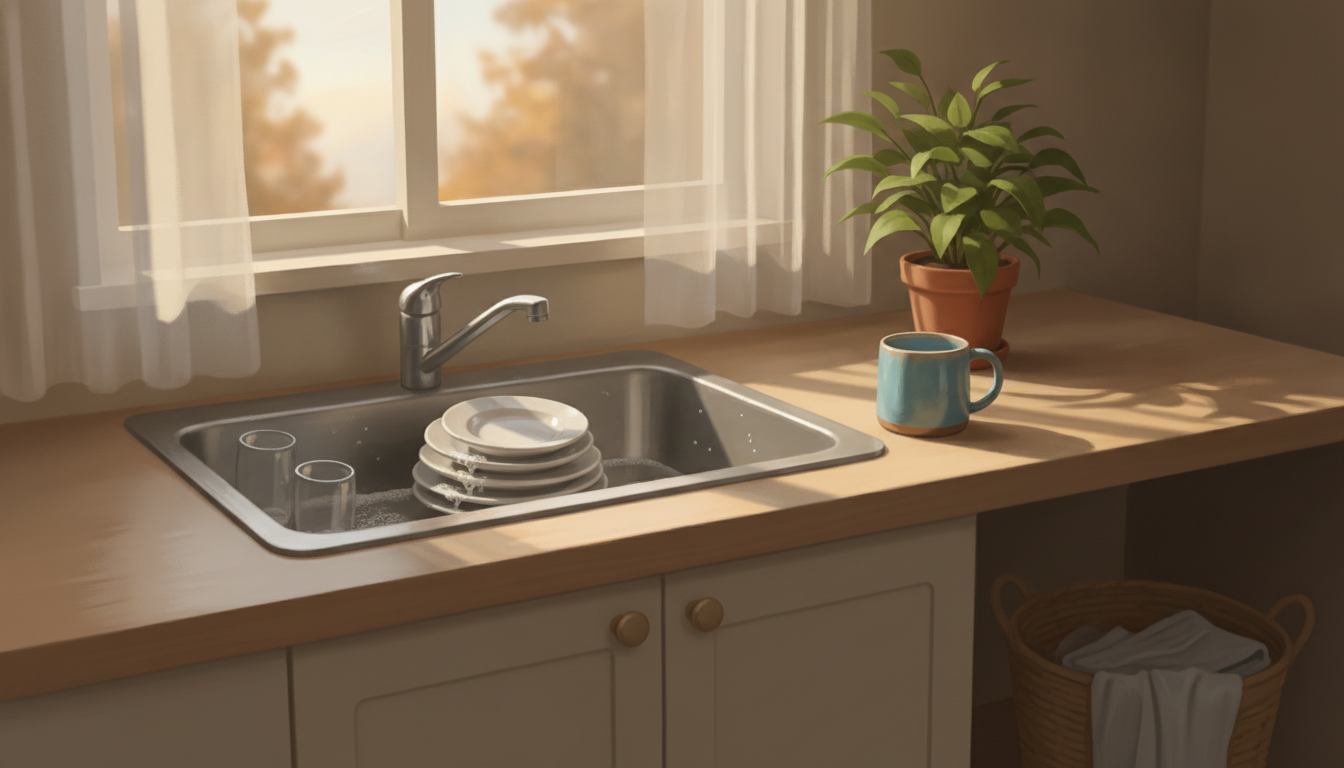
Wednesday, a little before nine in the evening. The laundry has been in the washing machine since Saturday, and you know without opening the door that it will need washing again. In the sink there are four plates, two glasses and a pan with rice stuck to the bottom. On the desk, Monday's mug still has a brown ring inside. You are on the sofa. The kitchen is eleven steps away. You have counted.
Earlier, on the phone, your mother said it kindly enough: “You just have to make a bit of an effort.” Now the sentence is playing again in your own voice, shrunk to one word. Lazy.
That word deserves a second look. Depression can make the most ordinary tasks feel enormous, and the person living with it can be the first to read that as a flaw in their character. What follows is general information. It is not a diagnosis, and it does not replace a doctor or a mental health professional.
The same kitchen on a tilted floor
Picture the floor of your flat tipped a few degrees. Nothing else has changed. The sink is where it was, and the plates weigh what they weighed last month. Every step toward them now goes uphill, though, and you are the only one who can feel the slope.
From the outside, nobody sees it. Your mother sees a flat floor and four plates. You see four plates at the top of a climb.
That slope is something depression really does. The NHS lists among its symptoms a lack of energy, moving or speaking more slowly than usual, finding it difficult to make decisions, and difficulties in home, work or family life. Each one tilts the floor a little more. Washing up takes a dozen small decisions (where to start, where the pan can soak, whether there is any soap left), and when deciding is itself tiring, the dozen add up.
Taynan Soares Gil Rodrigues, a psychologist and neuropsychologist, described it this October to the Brazilian health site Portal Drauzio Varella. A depressed person tries to keep up their usual pace, she said, while simple tasks stop being automatic and start to demand an exaggerated cognitive and physical effort. Automatic is the word to hold on to. Washing a mug used to happen on its own, somewhere between the kettle and your phone. Now it has to be planned, started and pushed through, like a job.
What the word lazy does to the slope
Shame feels as if it ought to work. Be hard enough on yourself, the thinking goes, and you will finally get up. In practice it tends to tilt the floor further.
Every undone task turns into evidence. The pan in the sink stops being a pan and becomes proof of who you are, and hardly anyone walks willingly toward proof against themselves. So you avoid the kitchen, the pile grows, and the next look at it hurts more. The NHS inform depression self-help guide, from Scotland's public health service, describes a similar loop: staying in bed all day can leave you more tired and feeling you have achieved nothing, and the things you do when you are depressed can keep the depression going. It also names the “should” rules people judge themselves by, with an example some readers will recognise: “I must vacuum the whole house every day.”
KC Davis, a therapist and the author of How to Keep House While Drowning, was blunt about it in a 2023 conversation on the TED podcast How to Be a Better Human. She said that whenever a client believed they were lazy, getting to the bottom of it always turned up something else: depression, motivation problems, overwhelm, burnout, physical pain. She suggests replacing the sentence “I'm failing” with another one: “I'm having a hard time right now, and people who are having a hard time deserve compassion.”
The second sentence will not wash the pan. It does stop the floor tilting further while you decide what to do about it.
How to walk a tilted floor
You cannot argue the floor flat. Pep talks do little on a slope, including the ones you give yourself. What you can change is how long each climb is and who makes it with you.
Make the climb shorter. “Do the dishes” is a hill. “Wash the mug” is a step. Pick one unit with clear edges, like the mug, or the clothes already sitting in the machine. Davis describes a ten-minute ritual. You set a timer, wash up until it rings, and stop, however much is left. Stopping on time matters as much as starting, because it teaches your mind that the climb has a top.
Take the flatter route. Davis's central phrase, from her book and her TEDx talk, is that care tasks are morally neutral. How well you keep up with laundry or cooking says nothing about whether you are a good person. On a tilted floor, that gives you permission to cut corners. Paper plates for a few weeks. Clean clothes dropped into a basket unfolded. For now the aim is a home that works well enough to look after you, and the standard can rise again when the floor levels out.
Do not wait to feel like it. On a slope, the wish to climb may arrive after the first few steps, or not at all, and that is allowed. The NHS inform guide, which is based on cognitive behavioural therapy, starts from a plan. It suggests a simple planner for three days, with one or two things you used to enjoy, something with other people, and the things you have to do, such as making meals and looking after yourself. It says this can improve your mood and how you feel about yourself, that it is fine for plans to change, and that you do not have to do everything at once.
Climb with someone. Ask a friend to stay on a video call while you load the machine, or to sit at the kitchen table with a coffee while you wash up. They do not have to help. Another person in the room can make the slope feel shorter. If you live with others, ask for one specific task, the bins or the pan, and say why: “I'm low at the moment, and this one is beyond me this week.”
When the slope keeps getting steeper
Sometimes the climb is more than a bad week. The NHS advises seeing a GP (your family doctor) if you have symptoms of depression for most of the day, every day, for more than two weeks. Go sooner if you have stopped eating properly, if washing or getting out of bed has been impossible for days, or if the heaviness has spread into everything. As Rodrigues puts it, you do not need to wait for things to get worse to ask for help. A doctor can also check whether something physical, such as a thyroid problem, anaemia or a side effect of a medicine, is adding to the tiredness. Depression can show up as a short fuse too, which we look at in when depression looks like irritability, or as a flat, colourless emptiness, which we describe in our piece on depression and emptiness.
If you have thoughts of dying or of hurting yourself, contact local emergency or crisis services now.
Saying “I can't even manage the dishes” out loud is hard, especially to the people who would see the dishes. NoOneToTalk offers anonymous listening from peers, a place to say that sentence with nobody looking at the state of your kitchen. It is a place to talk. It is not therapy, and it is not medical treatment.
Tonight the eleven steps will still be eleven steps. Try walking them once, for the mug only. Rinse it, turn it upside down on the rack, and go back to the sofa.
The plates can wait until tomorrow, when the floor may be a little less steep.
If you or someone you know is in crisis, please seek help. International directory: findahelpline.com.